September 10, 2026
Industry Compliance
Ofcom Price Rise Rules for Business Customers
by
The anvil team
Ofcom's ban on inflation-linked mid-contract price rises does not cover every business customer. It applies to a narrowly defined group of organisations where ten individuals or fewer work, and even those customers can expressly agree to different terms. This piece sets out where the boundary actually falls, what the market is charging larger business customers as at August 2026, and the three tiers of protection that are routinely confused with one another. It closes with seven practical steps for segmenting your base and running two contract templates without letting them drift into each other.


Ofcom's price rise rules don't cover most of your business customers. Here's where the line falls.
For UK resellers, ISPs and MSPs, the ban on inflation-linked price rises reaches a much smaller group than the market assumes: customers where ten individuals or fewer work. Apply it too widely and you give away pricing flexibility you were entitled to keep. Apply it too narrowly and you create contracts your customers may be able to exit.
Ofcom Price Rise Rules for Business Customers
A Reseller's Guide to Who Is Protected, Who Isn't, and What You Can Still Charge
About this guide
Last reviewed: 18 August 2026. Information believed correct as at that date.
This is a general guide for commercial, operations, product and compliance leaders in UK telecom reseller, ISP and MSP businesses. It is not legal or regulatory advice and is not a substitute for reading Ofcom’s General Conditions and guidance, or your own supplier contracts. Rules, guidance and provider terms in this area change frequently — always check the primary sources listed at the end and take professional advice before making decisions about your contracts, billing or marketing.
If you sell telecom services to businesses, the single most important thing to understand about Ofcom’s mid-contract price rise rules is this: they do not apply to all your customers. They apply to a specific, narrowly defined group of very small organisations. For everyone else, what you can charge mid-contract is a matter of what your contract says.
Getting that boundary wrong in either direction is expensive. Apply the rules where they don’t bite and you give away pricing flexibility you were entitled to keep. Miss them where they do bite and you create contracts your customers may be able to exit.
Why the rules exist at all
Ofcom acted after a period of steep inflation-linked increases. A House of Commons Library briefing records that some bills rose by more than 11% in 2022 and by up to 17% in 2023 [10]. Ofcom reported that around six in ten UK fixed broadband and mobile customers were on contracts with inflation-linked price rise terms as at April 2024, typically CPI or RPI plus 3.9% [9].
From 17 January 2025, Ofcom prohibited inflation-linked and other percentage-based price rise terms in new contracts, requiring any in-contract increase to be set out in pounds and pence instead [1][2].
Who the rules actually protect
This is the part most commonly misreported. Ofcom’s statement defines its scope as contracts for landline, broadband, mobile and pay TV services purchased by residential customers, Microenterprise or Small Enterprise Customers and Not-For-Profit Customers which it collectively calls “small business customers” including where bought as part of a bundle [1].
So business customers are in scope. But only some of them.
The 10-individual test
Under Ofcom’s General Conditions, “Microenterprise or Small Enterprise Customer” is a single consolidated definition covering a customer acting in the course of a business, which is not itself a communications provider, and for which not more than 10 individuals work whether as employees, volunteers or otherwise [4][8].
“Not-For-Profit Customer” uses the same headcount ceiling of 10 individuals, but excludes volunteers from the count, and additionally requires the organisation to apply its income to charitable or public purposes and be prohibited from distributing assets to members [4][8].
Two practical points worth internalising:
- There is no turnover or balance sheet test. Ofcom consulted on financial thresholds but did not adopt them. A ten-person business turning over £5m is a small business customer; a twelve-person business turning over £400k is not [4][8].
- It is headcount, not company size in any conventional sense. The EU-style “under 50 employees and €10m turnover” definition that circulates widely in secondary commentary is not the Ofcom test. Neither is “under 250”.
Ofcom has acknowledged that providers do not routinely hold headcount data for business customers, and has said it will take a pragmatic approach to compliance, looking at whether providers took reasonable steps to identify customer categories with proxies such as annual communications spend or number of lines being one route.
The bit almost everyone misses: small business customers can contract out
Ofcom’s General Condition C1 applies the contract requirements to Microenterprise or Small Enterprise Customers and Not-For-Profit Customers “unless they have expressly agreed otherwise” [4]. That carve-out does not exist for residential consumers.
Ofcom’s own customer-facing guidance reflects this, noting that different rules apply for small business and not-for-profit customers, and that providers have more flexibility to offer terms suiting the customer’s needs, meaning business contracts can include different types of price increase term [7].
This is a genuine commercial lever, but it is not a loophole to be used casually. An express agreement needs to be exactly that: express, documented, and evidenced. If your position rests on a waiver, take legal advice on how you obtain and record it.
What medium and large business customers can have
Once a customer employs more than 10 individuals, the General Condition C1 contract requirements including the pounds-and-pence obligation and the ban on percentage-based rise terms, do not apply to them [1][4][5].
There is no Ofcom cap, no formula restriction and no prescribed disclosure format for mid-contract price rises to those customers. What you can charge is governed by your negotiated contract terms and general contract law. Ofcom’s own business guidance reflects this reality, advising businesses with more than ten employees to check their terms carefully rather than relying on regulatory protection [6].
That larger-business freedom is being actively used across the market. As at August 2026:
Provider (business) - Mid-contract price rise mechanic
- Vodafone Business connectivity - CPI plus 3.9% a 3.4% CPI rate producing a 7.3% increase from 1 April 2026; a separate RPI increase of 4.2% also applies to some services [14]
- Three Business - Fixed banded rises each April (£0.50 / £0.75 / £1.50 by plan value) for most plans, but 4.5% each April on plans whose minimum term ends on or after 1 April 2026 and on Adapt and Dynamic plans [16]
- O2 Business - Business Tariff agreements from before 25 March 2021 rise by the RPI Rate announced each February; Small Biz Tariff agreements from 25 March 2021 to 8 January 2025 rise by RPI plus 3.9%; agreements from 9 January 2025 rise by £1.50 excluding VAT each April [15]
- BT Business - Fixed amounts for new and re-signing customers from 2 December 2024 from 1 April 2026, £4 per month on a broadband and digital phone bundle, £3 on broadband only, £0.50–£1.50 on voice services. Existing CPI plus 3.9% contracts continue on their original terms [11]
- EE Business - Fixed amounts for customers who signed or upgraded from 2 September 2024 — £3.00 per month excluding VAT on handset plans and £1.50 on SIM-only, tablet, laptop, watch and router plans, taking effect 31 March 2026 [12]
Two things stand out. First, percentage and index-linked mechanics are alive and well in the business channel. Second, several providers moved to fixed amounts before they had to - EE from September 2024 and BT from December 2024, both ahead of the January 2025 date [11][12] which tells you something about where market expectation is heading even where regulation does not reach.
The three tiers of business protection
It helps to hold the whole picture, because price rises are only one of several protections and they attach at different thresholds [5][6]:
- All businesses, any size. Providers must offer at least one 12-month contract for each service. Billing accuracy requirements, switching protections with compensation for failures, and number porting rights all apply.
- SMEs under 250 employees. Providers must publish information about their standard SME contracts, including any service level agreements and guarantees.
- 10 individuals or fewer. Key contract information in writing before the customer is bound, a contract summary, a 24-month maximum commitment period, no automatic renewal without express consent, complaints handling and access to Alternative Dispute Resolution plus the pounds-and-pence price rise requirements.
Note the mismatch: the “SME” threshold of under 250 employees exists in the General Conditions, but it carries only an information-publication duty. It is not the threshold for price rise protection. Conflating the two is the most common error in this area.
What the rules require where they do apply
For customers inside the 10-individual test, and for new contracts from 17 January 2025 [1]:
- No inflation-linked or percentage-based rise terms. The increase must be a fixed cash amount [1][2].
- Stated in pounds and pence, with timing, before the customer is bound. Ofcom expects this to be drawn to the customer’s attention prominently and comprehensibly, including during a sales call or in-store sale [1][3].
- Notice and exit if you go beyond what was agreed. Where a provider increases prices beyond what the customer agreed at sign-up, Ofcom’s business guidance states the customer must get at least one month’s notice and a right to exit without penalty [6]. This is the “material detriment” principle — regulatory shorthand for a change significant enough that the customer should be able to walk away.
Contracts entered into before 17 January 2025 are not caught; the rules apply to new contracts from that date [1].
Enforcement appetite is real. In October 2025 Ofcom publicly criticised O2 for raising mid-contract prices above the contracted amount, saying it went against the spirit of the rules [18].
Where this is heading
In November 2025 the Chancellor and the Secretary of State for Science, Innovation and Technology wrote to Ofcom on telecoms pricing and transparency, seeking an interim review by spring 2026 and a fuller review in 2027 [19]. Business customers are not specifically named in that letter, but resellers should plan on the basis that the current position is more likely to tighten than loosen.
Practical steps for resellers
A suggested starting framework adapt it to your own products, systems and legal advice.
- Segment your base by the right test. Not by SME/enterprise labels from your CRM, but by whether the customer falls inside or outside the 10-individual definition. Record how you determined it.
- Split by contract date. Pre- and post-17 January 2025 populations sit under different expectations.
- Run two contract templates, deliberately. One compliant small-business template with a fixed cash uplift; one negotiated template for larger customers. Do not let the small-business wording drift into large-account deals, or vice versa.
- Decide your position on express agreement. If you intend to rely on the C1 carve-out for any small business customer, get legal advice on how you capture and evidence it before you sell on that basis.
- Check what your own suppliers do to you. If your upstream contract carries CPI plus 3.9% or an RPI mechanic while your downstream small-business contracts carry a fixed £3, you have taken on margin risk. Model it.
- Configure billing to apply the stated amount on the stated date, and automate notifications with retained evidence that they were sent.
- Train the sales floor. Disclosure duties extend to verbal sales, so a phone sale can create exposure even where the paperwork is sound.
Advertising: what the ASA expects
The ASA’s regulatory statement on mid-contract price rises in telecoms advertising took effect on 15 December 2023, following a six-month grace period after the consultation closed in June 2023, introducing guidance on stating rises more prominently in ads [17]. The practical read-across for resellers is that an accurate contract sitting alongside a website implying price stability may still create a problem. Advertising guidance is updated periodically, so check the current position before signing off campaigns.
How anvil helps
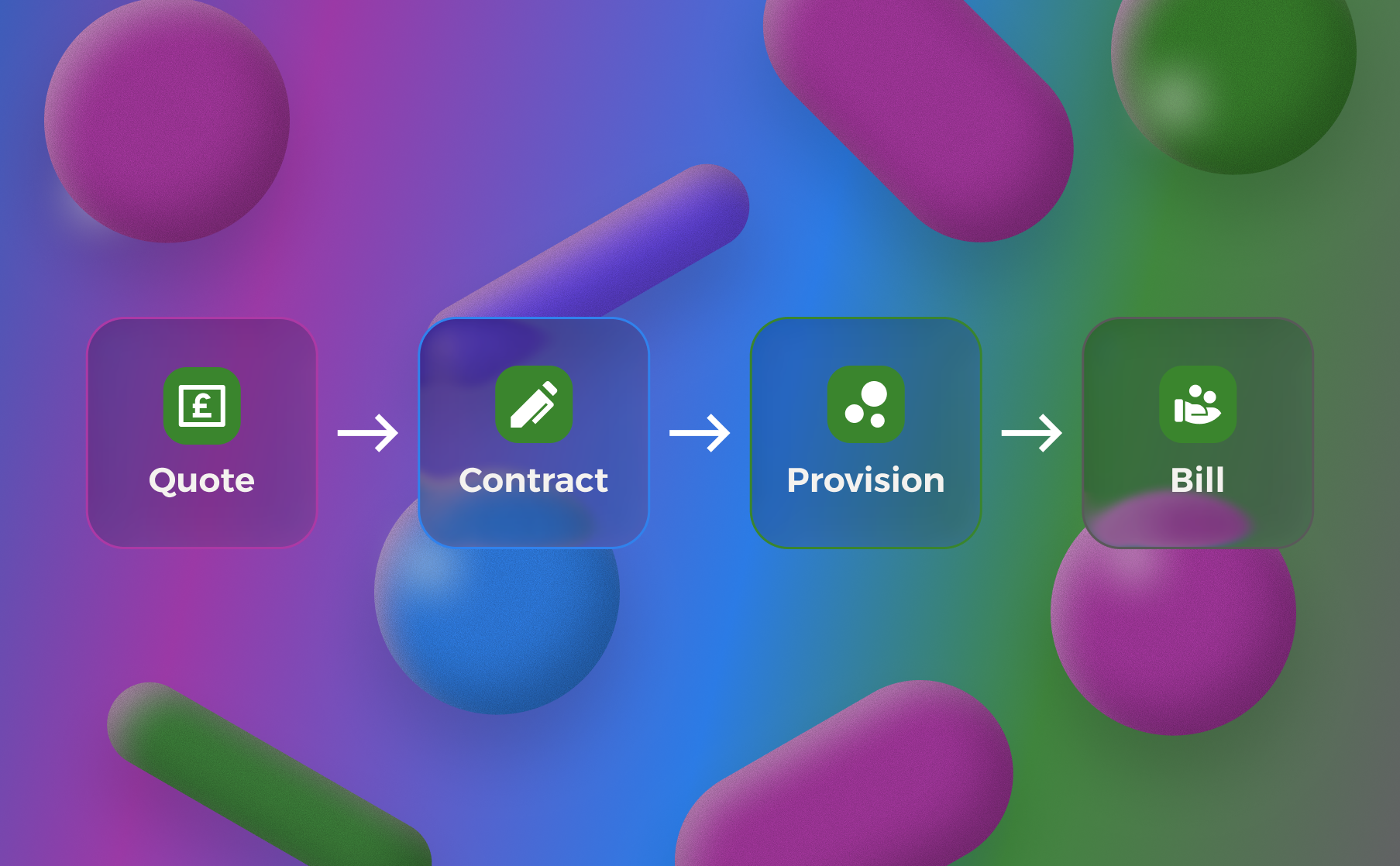
Everything above is, operationally, a segmentation and consistency problem. You are running at least four populations at once small business and larger business, pre- and post-January 2025 each with a different permitted price rise mechanic, and the same rise has to appear identically in a quote, a contract, a bill run, a notification and an audit trail.
That is the gap anvil is designed to close: a single platform for telecoms companies, ISPs and MSPs bringing CRM, operations and billing together rather than leaving them in separate systems [20].
Capabilities relevant to price increase management include:
- Price Increase management tools and billing, intended to apply the correct uplift fixed amount or negotiated mechanic to the right cohort on the right date, so what the customer was told and what the invoice says come from the same record [20].
- Contract Management System, Automated OFCOM Contracts and Single Contract Truth, aimed at holding one governed contract record per customer, which is what makes running multiple compliant templates workable rather than chaotic [20].
- Documentation Library and Complaints Register, keeping the evidence trail and the early-warning signal alongside the contracts they relate to [20].
- Custom and exception reporting, described as surfacing issues before invoices go out, so a rise applied to the wrong cohort is more likely to be caught internally than by a customer [21].
- Contract Retention and Centralised Quality, on the basis that the goal is not simply to apply a price rise but to keep the customer through it [20].
No platform makes a business compliant on its own compliance is a decision about how you sell and how you classify. What a system like anvil is built to do is reduce the manual steps where that decision quietly gets lost.
Where to start
If you cannot readily answer which of my customers sit inside the 10-individual definition, which contract mechanic each one carries, and what were they told at sign-up, that is the gap to close first. Every other decision here depends on knowing your own base.
Book a 30-minute review of your price-increase process, or download our Ofcom price-rise guide for UK telecom resellers.
Important notice
This guide is provided for general information only and reflects our understanding of publicly available material as at 18 August 2026. It does not constitute legal, regulatory or financial advice, and no warranty is given as to its accuracy, completeness or currency. The operative legal text is Ofcom’s General Conditions of Entitlement, and provider terms cited here are subject to change without notice. Ofcom and ASA rules, guidance and market practice change over time, and the sources below may have been updated since this guide was written. You should always refer to the current primary source material and obtain your own professional advice before acting. anvil and Fidelity Group accept no liability for any loss arising from reliance on this guide.
Guide first published: August 2026. Next scheduled review: February 2027.
Sources
All sources accessed 18 August 2026.
1. Ofcom — Statement: Prohibiting inflation-linked price rises, 19 July 2024 (PDF) — scope wording at paragraph 2.21
2. Ofcom — Ofcom bans mid-contract price rises linked to inflation
3. Ofcom — Review of inflation-linked telecoms price rises
4. Ofcom — General Conditions of Entitlement, unofficial consolidated version (PDF) — definitions and General Condition C1 scope
5. Ofcom — General Conditions that protect business customers
6. Ofcom — Advice for businesses: contracts
7. Ofcom — Telecoms price rises: what are your rights?
8. decoded.legal — Ofcom’s General Conditions of Entitlement: an update, with important changes (January 2022) — quotes the General Conditions definitions verbatim
9. Ofcom — Pricing trends for communications services in the UK, 2024 (PDF)
10. House of Commons Library — Customer protection in the mobile and broadband markets, CBP-9245 — periodically updated
11. BT Business — Pounds and pence price increases
12. EE Business — Pounds and pence price increases
13. Vodafone Business — Price changes
14. Vodafone Business — Connectivity price changes
15. O2 / Virgin Media Business — General Conditions for Business Customers, SMB, July 2025 (PDF)
16. Three Business — Changes to your monthly charge: annual price change
17. ASA — Regulatory statement: mid-contract price rises in telecoms contracts — guidance in force from 15 December 2023
18. Ofcom — Statement on O2 price rises, 30 October 2025
19. HM Treasury and DSIT — Telecoms pricing and transparency: letter to Ofcom, 25 November 2025
20. anvil — platform overview and module list
21. anvil — Advanced billing and contract management (anvil Access)
In Summary:
Know which rulebook each customer sits under
The hard part here is not reading the General Conditions. It is knowing, for every customer on your base, whether they sit inside the ten-individual test, which price rise mechanic their contract carries, and what they were actually told at sign-up. That is a segmentation problem before it is a legal one, and it gets solved in the systems where contracts, quotes, bill runs and notifications already live. If you cannot answer those three questions from one screen today, book a demo of anvil and we'll walk through how one contract truth keeps the right uplift on the right cohort on the right date.